Answred by Shaykh Yusuf Badat
Question:
How to attempt ghusl? What are the fard steps?
Answer:
Thank you for your question.
Ghusl (Ritual Islamic bath) is completed when one renders the following:
- Making the intention for ghusl (in accordance to some jurists)
- Washing the entire external body to the extent that not even a single hair is left dry
- Gargling and cleaning the nose (in accordance to most jurists)
Ali (may Allah be pleased with him) stated, “The one who leaves a hair’s span of filth from ritual impurity, without washing it, will be dealt with severely in the hell fire” [Abu Dawud]
Ibn `Abbas (may Allah be pleased with him) said, “When a person with ritual impurity takes a bath and forgets to rinse his mouth and nose, he should redo the cleaning of the mouth and nose.” [Dar Qutni]
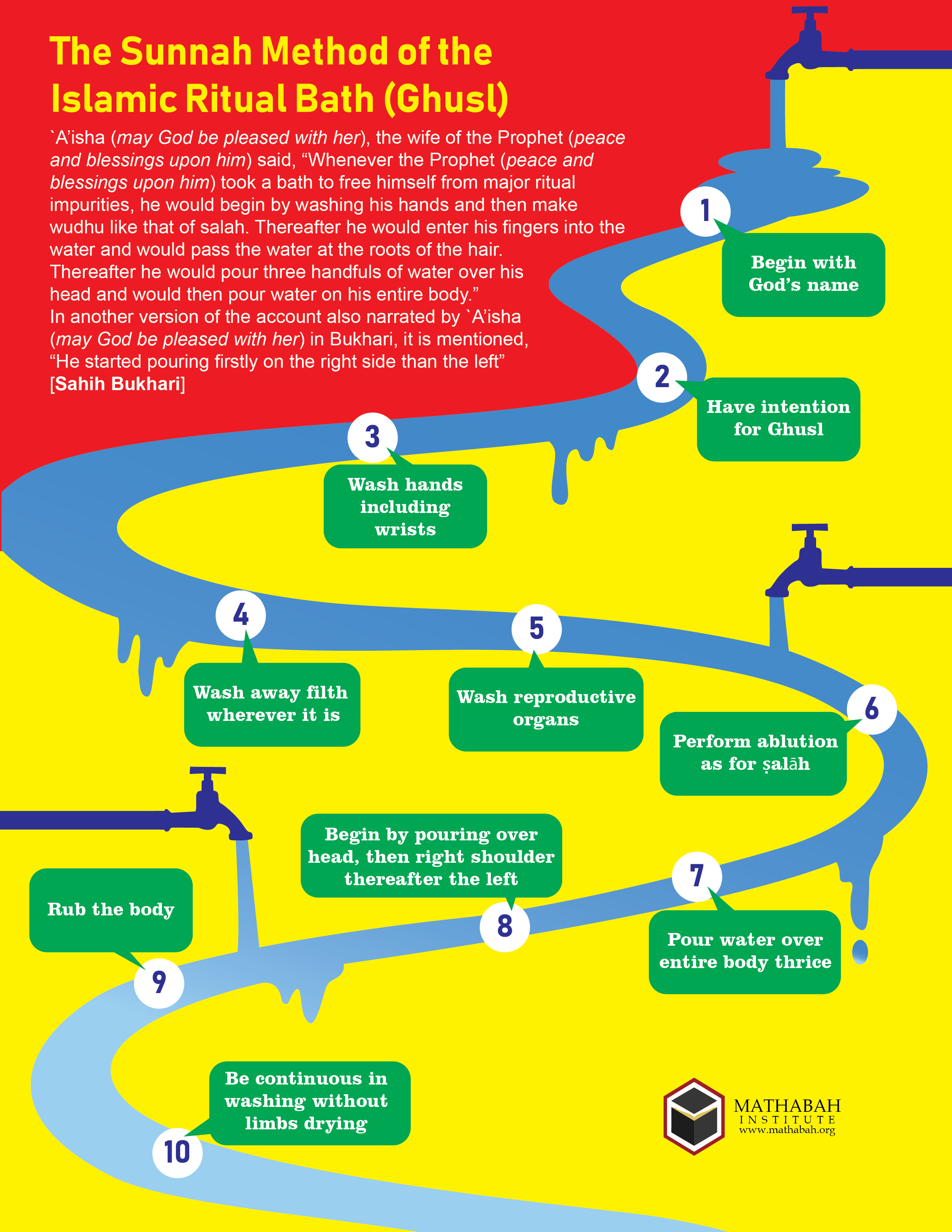
The Sunna Method of the Ritual Bath
- Begin with bismillah ‘In the Name of Allah the Most Beneficent, The Most Merciful’
- Make the intention of performing Ghusl
- Wash the hands up to and including the wrists
- Wash away any filth irrespective of where it is
- Wash the reproductive organs
- Perform wudhu’ as one does for saläh
- Pour water over the entire body thrice
- Begin by pouring water over the head, then the right shoulder thereafter the left
- Rub the body
- Be continuous in washing [one should not wait so long that the previously washed limbs become dry].
`A’isha (may Allah be pleased with him), the wife of the Prophet (peace and blessings upon him) said, “Whenever the Prophet (peace and blessings upon him) took a bath to free himself from major ritual impurities, he would begin by washing his hands and then make wudhu like that of salah. Thereafter he would enter his fingers into the water and would pass the water at the roots of the hair. Thereafter he would pour three handfuls of water over his head and would then pour water on his entire body.”
In another version of the account also narrated by `Ä’isha (may Allah be pleased with him) in Bukhari, it is mentioned, “He started pouring firstly on the right side than the left” [Sahih Bukhari]
And Allah Knows Best.